
Decision-Basis Brief
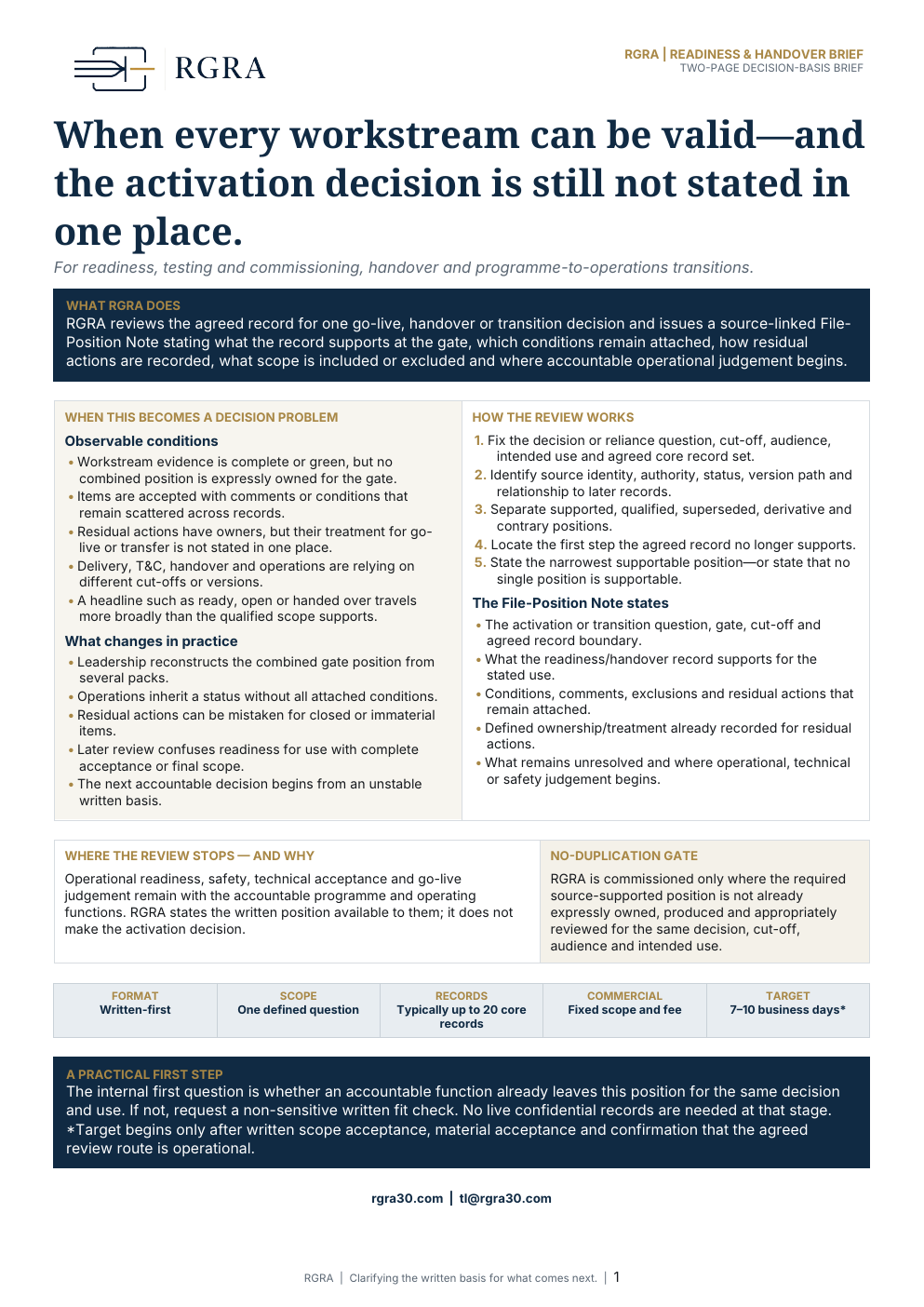
When every workstream can be valid — and the activation position is still not stated in one place.
For readiness, testing and commissioning, handover and programme-to-operations transitions where one bounded written position is needed at a defined gate.
Observable conditions
- Workstream evidence is complete or green, but no combined gate position is expressly owned.
- Accepted items retain comments or conditions across separate records.
- Residual actions have owners, but their treatment for go-live or transfer is not stated in one place.
- Delivery, T&C, handover and operations are relying on different cut-offs or versions.
RGRA output
A source-linked File-Position Note stating what the agreed readiness/handover record supports for the stated gate, the conditions and exclusions that remain attached, residual actions already recorded, unresolved points and where accountable operational, technical or safety judgement begins.
Boundary
The activation decision remains with the accountable programme and operating functions.
RGRA states the written record position available to them; it does not make the readiness, safety, technical acceptance or go-live judgement.
No-duplication gate
Existing integrated position? Stop there.
If the accountable programme already owns an adequate, appropriately reviewed source-supported position for the same decision, cut-off, audience and use, RGRA does not duplicate it.
Readiness & Handover Brief
See the complete two-page brief.
The brief carries the service definition, boundary, no-duplication rule and a public-record Elizabeth Line demonstration in one forwardable asset.
Practical first question
Does an accountable function already leave the integrated position for the same gate and use?
If not, a non-sensitive written fit check is enough to test whether the matter fits.