Fixed-scope written review
One decision question. One agreed record set. One controlled written position.
A Decision-Basis Review tests what the agreed record supports at a stated cut-off for one defined use. The output is a source-linked File-Position Note — or a formal limitation where the record cannot support one position.
Before any paid review
Start with the problem, not a ready-made question.
Tell us what is unclear in the written record. RGRA may propose multiple candidate documentary questions; the instructing client or partner approves the selected, bounded question(s), source set, cut-off, use and fee in writing. One accepted review unit never silently expands to cover every possible question.
*Timing and price are confirmed only in an accepted written scope, after material and information-route checks. No general delivery commitment is made here.
The review unit
The question and the file are bounded before analysis begins.
Decision / reliance point
The exact question the work is commissioned to clarify.
Cut-off
The date or controlled period against which the sources are read.
Record set
The agreed core sources; no silent expansion into an unlimited repository.
Intended use
The audience and downstream use the written position is prepared to support.
Process
Fit → Written Scope → Scope & Material Acceptance → Review & QA → Controlled Release
Fit
Check whether the requested written position is distinct, bounded and not already adequately produced by an accountable function.
Written Scope
Fix the question, cut-off, audience, intended use and proposed record boundary in writing.
Scope & Material Acceptance
Confirm the agreed source set, information route, commercial terms and the review route required for the intended use.
Review & QA
Trace source identity, authority, status and version path; preserve qualifications and contrary material; locate the first unsupported step.
Controlled Release
Issue the File-Position Note for the agreed audience and use, with the exact limit of support stated.
Possible outcomes
A valid review does not have to end in a clean “yes”.
Supportable
The agreed record supports one bounded position for the stated use.
Qualified / partial
The position is supportable only with stated conditions, exclusions or scope limits attached.
Unresolved
Competing or incomplete positions remain and must be carried explicitly.
Non-determinable
The agreed set does not establish the proposed statement at the cut-off.
What the recipient can inspect
See the File-Position Note structure before sending documents.
A format-only illustration shows the reviewable fields, the source trail, qualifications and the exact unsupported step. It is not a real client outcome, an expert opinion or a sample of confidential records.
Forwardable brief
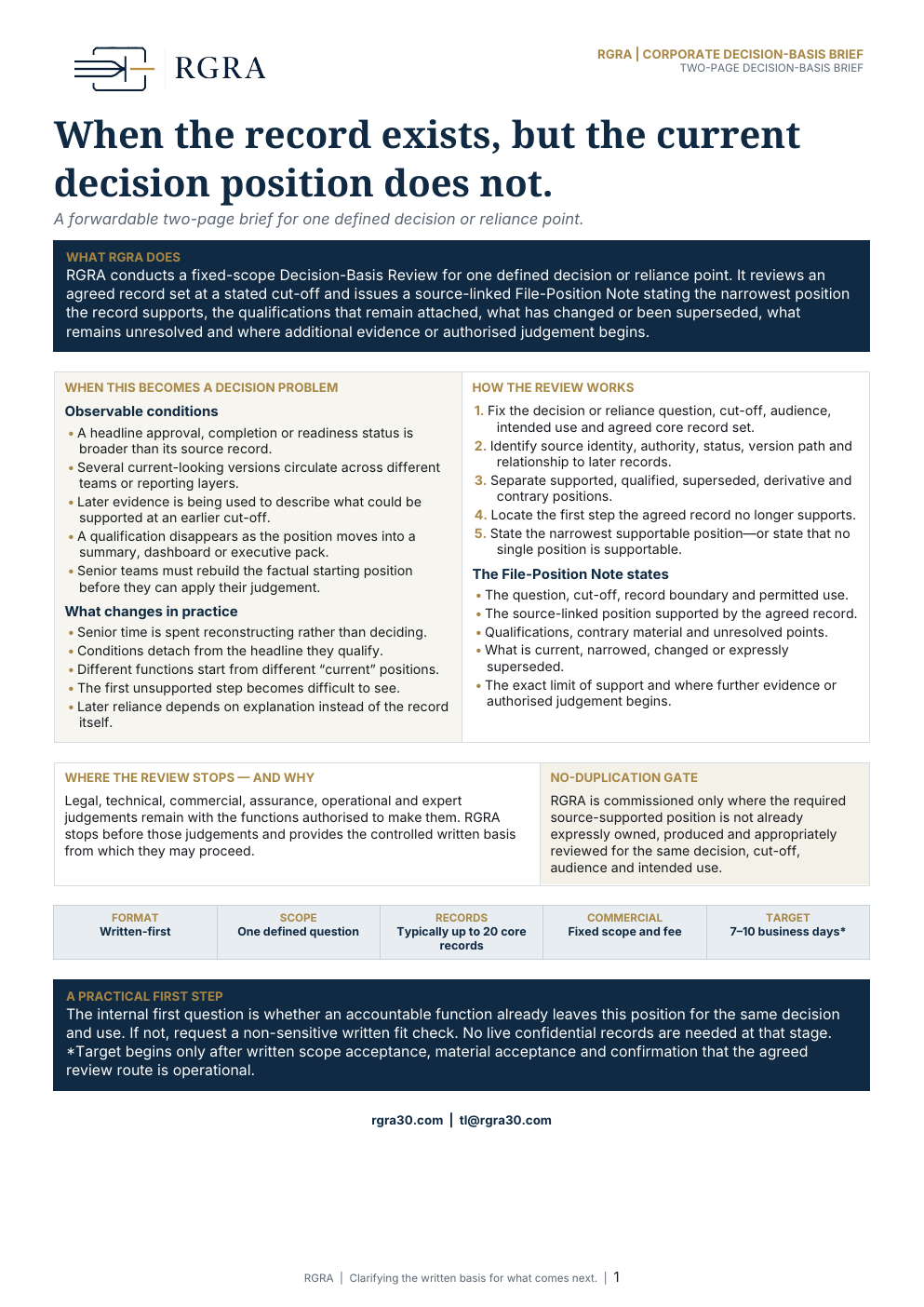
Corporate Decision-Basis Brief
A two-page explanation of the service, the review boundary, the deliverable and a public-record demonstration.